
John Fox Addresses the Future of Housing Management at the IHM
Delivered June 2, 2026
At the Institute of Housing Management, Robins Appleby LLP Partner and housing advocate John Fox delivered a keynote address examining the profound changes underway in Canada’s housing system and the critical role property managers will play in shaping its future. Drawing on decades of experience across the public, private, and non-profit sectors, he explored the growing tension between housing as an investment and housing as a human right, while highlighting how innovative partnerships and community-led solutions can preserve affordability. His remarks challenged housing professionals to lead with expertise, adaptability, and a commitment to building stronger, more resilient communities.
FIREWORKS AND SYSTEMIC CHANGE
I. INTRODUCTION
“This morning, I want to talk about housing—but more specifically, I want to talk about you and the role you play at a moment of real transition in Canada’s housing system.
Housing is everywhere right now. It’s on the front page, it’s a ballot issue, and it’s the subject of major government announcements every week. May 28 - 341 new units in Toronto, May 22 – 133 New units in Manitoba, May 21 – a new Partnership arrangement in Yukon.
From the outside, it can feel like a fireworks display. But the real question is whether what we’re seeing is just spectacle, or whether it signals a deeper, systemic shift in how housing works in this country.
That question matters because if real change is underway, if we are going to add hundreds of thousands of units including hundreds of thousands of below market units – someone will have to manage that, so making this work will land squarely on your desks.
I am both a lawyer and a housing advocate, and I’ve spent much of my career working in and around large housing systems—public as a lawyer and development executive with TCH, private through my clients, and non‑profit again as clients and friends.
What that experience has taught me is this: no housing policy succeeds, no new unit delivers stability, and no system change holds unless it is translated into day‑to‑day practice through good management. Without you, there is no systemic change
You are working in housing at a special moment. It’s a moment when a combination of public policy, private investment and an ambitious non-profit sector, scaling up and taking on more complex transactions, all the while tenants are more anxious, more informed, and more vulnerable to disruption than at any time in recent memory. And you are in the middle of that.
Today, I want to do three things. First, ground us in how we got here and why the signals feel so contradictory. Second, show you—through a real example—what systemic change can look like through the lens of a single transaction on a single building. And finally, talk about what I think needs to happen next, and therefore the challenges you will have to navigate. And I want to call to action to help keep the discourse in housing honest- to be willing to engage in difficult conversations that defy easy answers.
That is the work. And this is housing’s moment.
II. HOW I MET MY CAREER
So how did I come to see housing this way?
I am both a lawyer and what the Housing Sector calls a Houser. You already know what a lawyer is. A Houser is someone who believes that everyone deserves a safe place to call home—and is willing to do something to bring that about - practical, imperfect, sometimes uncomfortable to make that happen.
Housers often disagree on what “doing something” should look like, or what the most efficient use of resources is, but if you are engaged in the work of bringing housing to all Canadians, even one home at time, even one tenant experience at a time – you’re a Houser.
There are many paths into housing. Mine started in a place that had nothing to do with apartments, tenants, or communities: it was a speech about bridge, and a that speech changed the direction of my career.
The bridge is the Confederation Bridge that links New Brunswick to PEI. This is 2004 and at the time, Public Private Partnerships were relatively new and the confederation bridge was one of the leading examples. The Speech was at a conference called Canada’s Infrastructure Summit.
I was speaking second that day after Derek Ballantyne, then CEO of Toronto Community Housing. He didn’t come to talk about bridge or a theory of public private partnerships. He came to talk about redeveloping Regent Park.
This is the latest in a series of Regent Park Plans. How cool is that?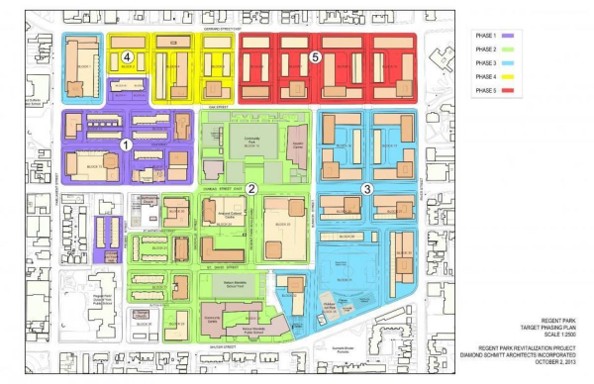
He put up the original regent park plan and then described their plans. It was ambitious – like rolling onion paper over a part of Toronto, drawing on it, and then making that drawing actually happen. And it was happening in consultation with Tenants. And he was pointing to parts of the plan that were related to what they were telling him. Like a pool with blinds that roll down- Because thats what the muslim comminuty needed. I wanted to be involved in THAT. The problem was – I still had to give a speech about a stupid bridge.
Derek finished and by the time I got to the front, there were only 4 people in the room. Me, my c-speaker and two guys who were checking their blackberries and realized too late that they were now stuck hearing about the bridge.
When it was over i started after Ballantyne because I wanted to help with Regent. I hovered at lunch until he sat down and sat beside him. I found out what parties he was going to from a mutual consultant and showed up.
And eventually, I became in house counsel at TCHC and I got to help bring that vision to fruition. And thats how I started in Housing.
Regent circa 2025 ©Isabelle Fox

Tenant Engagement
When I started, it was physical. It was contracts, and plans, and easements, and park fees. But When Toronto Community Housing took on the redevelopment of Lawrence Heights, I got to work at the point where plans meet people. I worked closely with tenants—not as a courtesy, but because their participation would determine whether the project succeeded or failed.
That work was hard. Tenants ask the hardest questions, and there were no easy answers:
- No, we are not rebuilding your existing building.
- Yes, your future unit will be smaller.
- No, I do not have funding for a drop-in centre.
It would have been far easier to tell people what they wanted to hear and let someone else deal with that. Instead, I made people cry. And yet, the same Somali mothers I had just disappointed would never let me leave without eating—because they felt I was too thin. When it came time for public meetings, the same women would deliberate before telling which suit they wanted me to wear.
I keep a photograph of that group of tenant advocates in my office because they are my housing heros. they taught me that tenants do not expect perfection—they expect fairness, honesty, and dignity. If you tell them something and they tell their community, you better not go back on that. They were untrained, had so little money, were deeply invested in their community, and determined to build a better life for themselves and the people around them – even if it meant putting a wrecking ball through their living rooms during the redevelopment.
I am going to talk systemic change, new units, and big programs—but my experience tells me this: without compassionate, disciplined communication, without being able to engage tenants, none of it holds. Property managers – whether you’re TCH or you’re a condo manager - are the ones who absorb change, translate it into daily practice, and decide—conversation by conversation—whether housing policy becomes housing stability.
Which brings us to the question we started with: will all of those announcement yield a big enough change to change the way you operate. Are we watching fireworks—or are we living through structural change?
To answer that, we need to be honest about where we are now. And if you follow housing coverage closely, you already know why that is so hard to see.
III. WHERE WE ARE NOW
It would be comforting to summarize the housing landscape with a clean set of statistics. But if you read the press—or live this work—you know the signals are contradictory.
- On one hand, we have a supply problem on the other hand builders have unsold inventory that they are prepared to bundle and sell at a discount – because there is no market for some of their units.
- We hear rents are unaffordable yet rents on new builds in Toronto are down substantially year over year according to their ownership groups.
- Housing advocates raise alarms about improper evictions, BUT the government of Ontario takes action to make eviction easier, because its too hard and too long to get an eviction order.
- There are announcements about new housing all the time, but for every new affordable home we create, we lose 10 on average across Canada as properties are redeveloped and repositioned for higher rents.
- We introduce legislation, Bill 10, that appears to hold landlords responsible for drug activity in their buildings, while simultaneously asking those same landlords and managers to keep tenants with addictions, mental‑health challenges, and complex needs housed.
If the present is confusing, let’s look to the past for some direction.
Fincialization
For the past 30 years, the dominant organizing principle in the creation of new housing has been return on investment. Whether we are talking about new construction or the acquisition of existing buildings, capital flows where returns are predictable and better than the next investment. That is not a moral judgment—it is simply how the system has been designed to work.
AND This approach has delivered a great deal of housing. I could not find an aggregate single statistic, but aggregating from CMHC resources yields about 9M homes between 1995 and 2025. That liberalized housing system – that is, directed by private interests, has attracted global capital, created a world‑class construction industry, and created a professional property‑management sector that is among the strongest anywhere.
But it has also concentrated ownership, accelerated rent growth in existing stock, and distributed housing primarily by ability to pay rather than by need or stability.
The contradictions we’re living with—low vacancies and rising evictions, unsold inventory alongside unaffordability, are the logical outcome of how we have chosen to organize housing.
This process is referred to as the financialization of Housing. This is not new. It is not even partisan. The process accelerated in the last 30 years under the guidance of both Liberal and Conservative Governments, with the the withdrawal of the federal government from housing and the introduction of new vehicles that facilitated investment – and speculation - on housing. Financialization is sometimes used a pejorative – I don’t mean it to be. I mean it as a description of the rules we’ve been playing by. And it explains why the system struggles to deliver stability—When housing is optimized for financial performance, displacement is not a failure of the system. It is a feature of it.
Since we have been running this experiment in liberalization for 30 years, we should be honest about some of the results in assessing how to go forward:
- CMHC’s latest “Rental Market Report” (2024) details the increasing share of housing stock owned by institutional investors and large landlords, particularly in major metropolitan areas. (CMHC, Rental Market Report, 2024).
- Our market today is almost entirely private market–for–profit players, accounting for about 96 percent of housing. The remaining approximately 4% is in the hands of non-profits, like Durham Region Non Profit Hosing Corporation, Co-ops, and public housing owned by government, like the Northumberland Community Housing Corporation.
That 4% represents about 600,000 homes. According to ScotiaBank in 2003 that’s about half the OECD Average. - All of this disproportionately impacts marginalized communities. As Researcher Martine August points out, if housing is going to the highest bidder, marginalized communities are going to have more difficulty breaking through.
The Right to Housing
If a fully liberalized housing market is one end of the spectrum, at the other are housing advocates and the conviction – enshrined both at the United Nations and in Canadian Law, that Housing is a Human Right. As Leilani Farha, former UN Special Rapporteur on the Right to Housing, has stated: “Housing cannot be treated as a commodity; it must be seen as a human right, not an investment opportunity.”
The Human Right to Housing is a progressive right, meaning it is the responsibility of states to move towards an equitable system that provides adequate housing for all. Adequate housing means, security of tenure, access to safe drinking water and other basic services, affordability, habitability, accessibility, location (proximity to employment, for example, and cultural adequacy.[1] In short, instead of asking if a building performs on economic metrics, a human rights advocate asks if it meets the needs of its residents.
- Security of Tenure – Protection against forced or arbitrary eviction; includes legal, rental, or cooperative arrangements.
- Availability of Services & Infrastructure – Access to safe water, sanitation, energy/cooking facilities, refuse disposal, site drainage, emergency services, etc.
- Affordability – Costs that do not threaten ability to meet other basic needs; may include subsidies or rent controls.
- Habitability – Sufficient space, protection from weather and structural hazards; ensures safe and healthy living conditions.
- Accessibility – Especially for disadvantaged groups (e.g., elderly, disabled); includes access to basic services and mobility options.
- Location – Proximity to employment, healthcare, schools, childcare, and other social amenities; avoids environmental hazards.
- Cultural Adequacy – Respect for cultural identity and traditions, including architectural design and cultural norms.
These two frameworks now operating in the same system at the same time, each yielding competing expectations. And that tension lands with you. Property managers are asked to uphold financial discipline and human dignity. To enforce rules and prevent harm. To keep buildings viable while minimizing displacement.
How do we balance – can we balance - private interests with the need for safe, stable housing? A collection of policies and actions that attempts to thread that needle can lead to systemic change. If it does not, its just fireworks.
IV. THE CAROLINE CO-OP
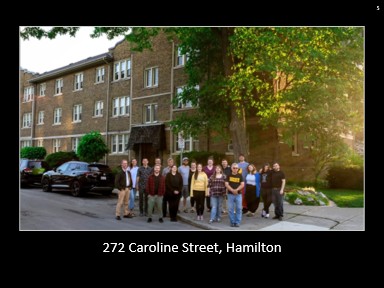
So, what does it look like when these two frameworks—the financial logic of housing and the human right to housing—collide in the real world? In an actual building, with real tenants, real capital, and real risk.
This is 272 Caroline Street in Hamilton.
When our story begins in 2023, it is a privately owned, rent‑controlled building with long‑term tenants paying well below market rent. From a financial perspective, it is underperforming. From a human‑rights perspective, it is doing exactly what housing is supposed to do: providing stability, predictability, and affordability to people who have built their lives there.
Then the building goes up for sale.
What happens next is not unusual in today’s housing system. A buyer could reasonably look at that building, assume turnover, consider ab above‑guideline rent increases to offset renovations, and reposition the asset. That would be rational. It would be legal. In many instances, it will result in displacement.
But this story takes a different turn.
By coincidence, one of the tenants works for a non‑profit and her job is to monitor real‑estate listings in Hamilton. She sees her own building for sale. She knows exactly what that can mean. She decides to take matters in hand. She starts knocking on doors to find allies. The tenants know one another, but not well. They get outside help. They ask a radical but practical question: What if we bought the building ourselves?
Under normal circumstances, buying a small apartment building is straightforward. A buyer puts in some equity, borrows the rest against the building’s future rental income, and closes the deal. Banks are comfortable because the buyer has capital, experience, and scale.
What did the tenants lack?: capital experience and scale.
The tenants had no balance sheet, no retained earnings, and no acquisition program designed for them. Yet they were trying to compete in the open market for a multi‑million‑dollar building. To make that possible, we had to assemble a financing structure that replaced private equity with layered public and social capital.
Here’s how it worked.
- First, we needed deposit money, which tenants typically cannot access. That was solved through a short‑term, turnkey loan—essentially bridge capital—to get the deal under contract – from a local philanthropist.
- Second, we secured a first mortgage from a credit union willing to lend based on the building’s encumbered income.
- Third, because that mortgage alone wasn’t enough to close the gap, we added mezzanine financing from a socially motivated lender—capital that sat behind the first mortgage in exchange for a potentially higher return.
- Fourth, the City of Hamilton contributed a forgivable loan, not to make the deal profitable, but to make it possible—recognizing that preserving existing affordable units was far cheaper than replacing them.
- Finally, because different funding sources arrived on different timelines, we used bridge financing to carry the transaction until long‑term CMHC funding could be put in place.
To legally hold all of this together, the tenants had to form a co‑operative corporation, which became the actual owner of the building.
None of this was elegant. It took eighteen months to close a deal that would normally take three. But the result is that 21 units were preserved as affordable housing at a public cost of roughly $25,000 per unit—a fraction of the cost of building new.
That is what it takes, today, to reconcile financial reality with the right to housing.
So, let’s summarize: The Tenants formed themselves into a co-op and bought their own building, giving themselves control over their rental destiny. This transaction ensures that these 21 units will remain affordable for a long time. The multiple levels of financing underscore the challenges for non-profit actors seeking to buy at market rates – it’s so daunting. However, through a series of financial instruments, the tenants definciancialized their own building.
Lessons from Caroline Co-operative
Caroline Street is a hopeful story, but it is not a comfortable one. Why would the tenants go through all of this?
I. First, housing precarity is often invisible—until it isn’t. These tenants were stable, long‑term residents in a well‑functioning building. But the moment the asset was listed for sale, that stability came into question.
More than 1.8 million Canadian households spend over 30% of their income on shelter costs, which exceeds the affordability threshold set by CMHC (CMHC, Rental Market Report, 2024). Our Hamiltonians were not among those spending in excess of 30% (as far as I know). They feared they soon would be. They feared this because at the time this was happening, rents had increased in Hamilton by almost 13% year over year and wait times for public housing were long. Nor where they in a position to buy. Year over year home prices declined in the 2025, but still north of $700,000 on average, so remains out of touch for most of the Caroline Tenants.
II. Second, preserving affordability is dramatically cheaper than rebuilding it. The total cost of purchase was about $250,000 per unit. public cost to secure these 21 units was roughly $25,000 per unit. New construction down the street at the time was approximately $600,000 in cost and $150,000 per door in public subsidy.
III. Third, non‑profit ownership does not eliminate the need for professional management—it heightens it. First, the tenants knew the building needed repairs, so the quality of the due diligence – whether they reserved enough to cover that is directly related to whether they will succeed or not. And then, once the transaction closed, the financial complexity didn’t disappear. It shifted into long‑term operational responsibility: maintaining the building, enforcing rules, managing cash flow, and supporting a diverse tenant community under tight margins. There is little room for error, regardless of who is actually doing the work.
V. WHAT TO DO ABOUT ALL OF THIS?
If we accept the reality I’ve just described that we live with two competing, but not incompatible systems, then the path forward becomes clearer—even if it is not easy.
First, we need more housing in the Community Housing Sector.
Let me repeat one stat - Canada’s community housing stock is about half the OECD Average. We are at about 4%, the OECD Average is 7-8%. We need to target at least doubling that and, the Canadian Centre for Transformation has called for 20%. Since doubling that number is, by any measure ambitious – doubling would mean adding about 600,000 units.
Enter Build Canada Homes – The federal government’s major response to creating more housing – and they are clearly aimed at below market housing, with most of the programming relating to for profits staying at CMHC. First, let’s give that team at BCH some runway. It took 30 years to get us into this housing crisis. They will not get us out of it in 30 months.
Its not time to complain yet. Its time for constructive feedback. So here is some advice for BCH:
- We love the announcements, but focus on the systems of Housing - If you want modern methods of construction, then make it easier to enter into those transactions. Support the infrastructure that delivers it. Intervene in the legislative process where there are roadblocks to housing creation. Use your weight to get the contracts right, get the bonding to work and then, make that all open source.
- If you want affordability, keep the good parts of CMHC’s programs. The Affordable Housing Fund was a great program because it created genuine affordability through forgivable loans. That program has come to an end, leaving some projects stranded and struggling. Keep doing that.
- If preserving affordability is the goal, acquisition and preservation have to be a central strategy. The most inexpensive affordable homes we have are the ones that already exist older rental buildings with long-term tenants, lower rents, and functioning communities. The Caroline Co-ops. Once those buildings are sold, repositioned, or demolished, affordability disappears far faster than we can rebuild it. As I noted at about a 10 to 1 ratio across Canada
That is why acquisition funds and rental protection programs matter. In British Columbia, the Rental Protection Fund was created to help non-profits buy at-risk rental housing and preserve affordability over the long term, and it has already shown that preservation can happen at scale. In the fiscal that ended for them in the summer of 2025, one half of all multi-residential transactions in BC that year involved the fund.
Federally, the Canada Rental Protection Fund is about to be launched. It is a 1.5-billion-dollar national program aimed at the same target – to acquire existing residential buildings and increase the amount of housing in non-profit hands.
There are also private interventions that will help put more housing into community hands. Let me share two with you:
- There is an emerging philanthropic effort to support housing. Without Philanthropy, Caroline Co-op could not have happened. Partners for Affordable Housing raises money with a view to filling gaps in capital stacks for non-profits. I think its sufficiently important that I joined its board last month.
- Land trusts belong in that conversation as well. Their value is simple but profound: they take land out of speculation and hold it for community benefit, making long-term affordability easier to protect. A great example of community land trust is the Parkdale Neighbourhood Land Trust in Toronto, which acquires residential buildings in Parkdale in order to preserve affordability.
The point is not that every building should become a co-op or sit in a land trust. In fact, when we talk about doubling community housing, it may seem radical, but it only aligns us with the rest of the OECD and, if achieved, leaves 92% of housing in for-profit hands.
The point is that with a major federal intervention through Build Canada Homes, and the acquisition programs, we now have workable tools to preserve affordability before it is lost—and that begins to feel like systemic change.
Let me complete the case for putting more housing into non-profit hands – Its cheaper. People tend to balk at creating housing because its expensive. But operationally, it’s cheap by comparison. The next time that comes up, ask: if not in housing, where to people go? The University Health Network in Toronto has been considering that question – as they focus on housing as an element of health care. The provision of supportive housing, whether for patients with disabilities and addictions, costs about $3,500 per month. If not there, then were. To a shelter, for $7,500? To jail for $15,000? To the hospital for $50,000? If you’re a fiscal conservative, housing is your answer.
Just yesterday, the Canadian Centre for Economic Analysis and Scotia Bank published a report describing the benefits of investing in public housing. They looked at 5 different scenarios, landing on a model combining renewing existing infrastructure and expanding the portfolio and came to the conclusion that that could yield a 3 to 1 ratio in quantified benefits. That is, for every dollar invested in housing, there is nearly three dollars in economic benefits, in jobs, avoided hospitals, and lower use of shelters.
It comes off as ironic to say it, but we need non-profit housing just to be able to balance the books.
So, there’s my first ask – More units in community housing.
Second, the non-profit housing sector must scale—and mature—quickly.
If we are going to put more housing into the hands of non-profits, then – are they up the task?
I say yes. And that sophistication is represented in the room. When I act for non-profits a lawyer, I get a front row seat to some of the sophisticated an ambitious work that is going on. Let’s take an example from this room: Durham Region Non-Profit Housing Corporation’s deal with Daniels in Oshawa, which is combining land acquisition, design-build contracting, and public financing to create new affordable rental housing. That’s a win/ win for everyone. We get affordable housing; Daniels uses its expertise and monetizes its dormant land. Its also the first deal I know to have created a regime for dealing with unknown Tariff impacts – it’s a pioneer. They are not alone:
- Woodgreen entered into a long-term lease with Daniels and Sunlife to rent 40 units in a market building in Toronto.
- Habitat did a deal with Tribute Homes to put a floor of affordable ownership in a condo building, in exchange for which, they received 4 additional floors
If those were the only examples, I’d be out of a job!
Things are changing out there – and this impacts you.
Third, property management must be treated as core infrastructure, not a back-office function.
That growth will change property management. In some cases, you will report into organizations whose priorities are not purely financial. If you had been working for the owner of Caroline co-op, your tenants would have become your bosses overnight.
In others, you will manage buildings where affordability covenants, public funders, community expectations, and tenant vulnerability all shape the operating environment. And in condominium settings, if blocks of unsold units are acquired and converted into long-term rental or affordable housing managed by non-profits, board dynamics and governance expectations are going to change as well.
I really want to stress this point, because policy fails if it cannot be carried through daily operations. New ownership models, and greater legal and public scrutiny all land at the building level. That means the work of property management – the on-site staff - is becoming more demanding, more skilled, and more consequential. The owners of Disney World are less consequential to visitors then the maintenance team – not because they do the cleaning, but because they answer the questions. No different in housing.
If Canada wants more community housing, then we need to invest in the people who actually run community housing. That means training, systems, staffing, compliance capacity, and leadership. It means recognizing that operating a building well is not a secondary task to development; it is what determines whether a housing intervention actually succeeds.
And if the community housing sector is going to grow in the way many of us hope it will, there is simply no path to success without property management capable of absorbing that growth and carrying its operational weight.
I have spoken today about the tension between a market organized around returns and a system that increasingly speaks in the language of rights. But most tenants do not experience that tension as theory. They experience it as treatment. Whether a building is owned by a private landlord, a co-op, or a non-profit, tenants care about whether they are dealt with fairly, clearly, and with dignity.
Only you can deliver that.
CONCLUSION
Let me close where I began. Are we witnessing fireworks or systemic change?
The case I am making is that we are witnessing a collection of changes that, collectively, optimistically, could be systemic. What happens if we deliberately move existing units to the community housing space? If we engage in sustained construction of below market units, if we make it easier for non-profits to build, if the Community Housing Sector – non-profits, coops and land trusts are up to the task?
What if we housing professionals keep this conversation going every day – by challenging others who think housing is somehow easy?
What happens when we manage to use for-profit expertise to advance public good? Its not the first time.
What if we invest in professional management that is capable of running buildings and can meet the needs of an increasingly diverse tenancy?
I grant you, I am an optimist. But I can connect all of those dots into a better future for housing in Canada.
Thank you”.
/john-fox.tmb-cfthumb_s.webp?Culture=en&sfvrsn=4c040103_2)